AI & Engineering Productivity
How BrighterWorks Labs Reduced Developer Lead Time by 68% Using an AI-Powered Engineering Agent
An AI engineering agent across the full SDLC: risk-based routing, automated context gathering, quality gates, and human review that scales with risk.
68%
Average lead time reduction
4
Risk-based delivery paths
100%
Changes pass validation gates
The Problem
A few months ago, we started asking a question that many engineering organizations are beginning to explore: What if developers spent less time moving tickets through the software delivery process and more time solving actual business problems?
Like many growing engineering organizations, we faced familiar challenges. Engineers spent significant time understanding tickets before writing code. Context switching between Jira, documentation, source code, and pull requests slowed delivery. Small and repetitive changes consumed the same process overhead as larger initiatives.
The problem wasn't that our engineers were unproductive. The problem was that too much engineering time was being spent on activities surrounding software development rather than software development itself.
We decided to experiment with a different approach. Instead of building another AI coding assistant, we built an AI Engineering Agent capable of participating in the entire software delivery lifecycle.
The Goal
Our objective was not to replace engineers. Our objective was to remove friction.
We wanted an intelligent system that could understand Jira tickets, gather technical context, assess implementation risk, create implementation plans, generate code changes, run validation checks, prepare pull requests, and learn from outcomes.
Most importantly, we wanted human involvement to scale based on risk.
Designing a Risk-Based Delivery Model
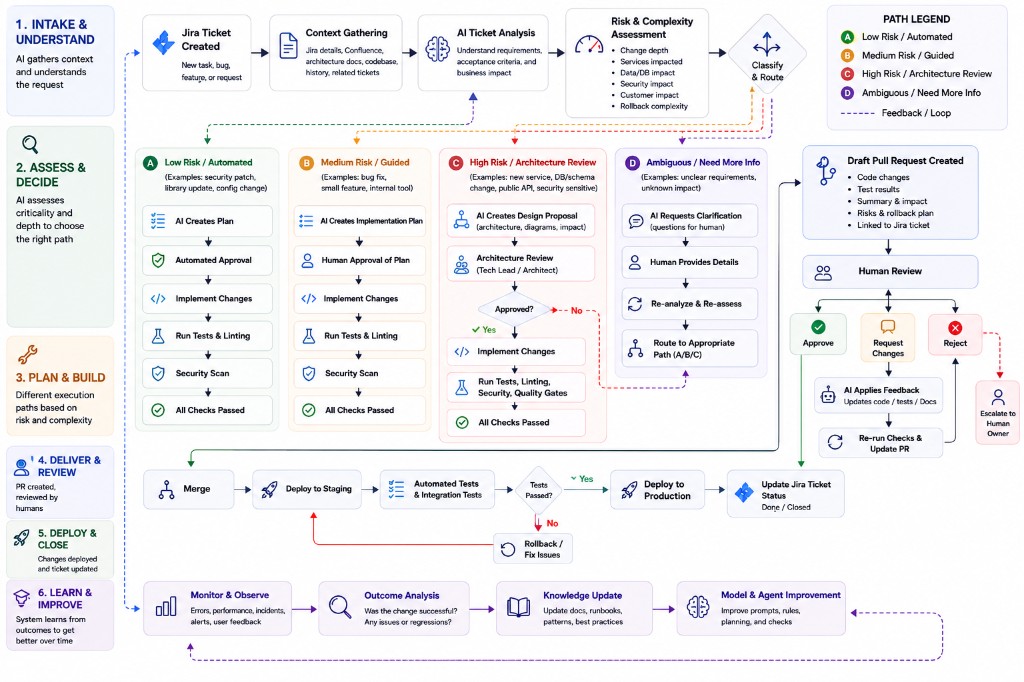
One of the first lessons we learned was that not all engineering work deserves the same workflow. Traditional software delivery treats most tickets similarly. The AI agent instead classifies work into four categories.
Path A: Low Risk / Automated
- Security patch updates
- Dependency upgrades
- Configuration changes
- Documentation updates
- Internal tooling improvements
- Analyze the request
- Create an implementation plan
- Apply the changes
- Run tests and security scans
- Create a pull request automatically
Path B: Medium Risk / Guided
The agent first produces a detailed implementation plan. The plan is reviewed and approved by an engineer before code generation begins. This created an important balance between speed and control.
- Bug fixes
- Small feature enhancements
- Internal API modifications
Path C: High Risk / Architecture Review
For these requests, the agent behaves more like a staff engineer than a coding assistant. Before any implementation work begins, it produces architecture proposals, impact assessments, service dependency analysis, risk evaluations, and rollback strategies. Only after architecture approval does implementation begin.
- Database schema changes
- New services
- Public API changes
- Security-sensitive functionality
Path D: Ambiguous Requirements
One surprising discovery was how many tickets contained incomplete information. Rather than making assumptions, the agent requests clarification. Once additional information is provided, the ticket is reassessed and routed into the appropriate delivery path. This significantly reduced rework caused by misunderstood requirements.
Beyond Code Generation
Many AI engineering discussions focus entirely on code generation. In practice, code generation was not where we achieved the biggest gains.
The largest improvements came from automating engineering context gathering. When a ticket arrives, the agent automatically analyzes Jira descriptions, linked documentation, previous tickets, historical pull requests, service ownership information, and source code structure.
By the time an engineer opens a ticket, much of the investigative work has already been completed. This reduced onboarding time for new work items dramatically.
Building Quality Gates
Trust was critical. No engineering leader wants an autonomous system deploying unverified changes.
Every generated change passes through multiple validation layers. If any stage fails, the agent attempts remediation automatically. When remediation is unsuccessful, the issue is escalated to an engineer.
- Unit tests
- Integration tests
- Static code analysis
- Security scanning
- Quality checks
- Acceptance criteria validation
Intelligent Pull Requests
One of the most appreciated features turned out to be automated pull request creation. Reviewers no longer need to spend time reconstructing the purpose of a change. The context arrives with the code.
- Change summary
- Business and technical impact
- Files modified
- Test evidence
- Risk assessment
- Rollback strategy
- Jira linkage
Human Review Remains Essential
Despite advances in AI, we intentionally preserved human review. Engineers can approve changes, request modifications, or reject implementations.
When feedback is provided, the agent updates the implementation, reruns validations, and refreshes the pull request automatically.
The best results occurred when engineers focused on architectural decisions while the agent handled execution details.
Deployment and Continuous Learning
After approval and merge, changes deploy to staging where automated smoke tests and integration tests execute. Successful validations trigger production deployment. Failures trigger rollback and remediation workflows.
Once deployed, the agent monitors incident reports, performance degradation, operational alerts, user feedback, and rollback events. Outcomes feed a continuous learning system that improves risk classification, planning quality, testing strategies, and implementation patterns.
Results After Several Months
While results varied across teams and repositories, several trends became clear.
Lead Time Reduction
Average ticket lead time decreased by approximately 68%. Much of the improvement came from eliminating waiting periods between workflow stages.
Faster Implementation
Routine engineering work that previously required several hours often moved from ticket creation to pull request generation within minutes.
Higher Engineering Focus
- Less time searching for context, preparing pull requests, and handling dependency maintenance
- More time on architecture, product discussions, system design, and customer-facing improvements
Improved Consistency
Every ticket followed a structured process. Every pull request included standardized information. Every change passed through the same validation framework. The result was greater predictability across teams.
What We Learned
The biggest lesson was unexpected. The challenge was never generating code. Modern AI systems are already capable of producing code.
The real challenge is understanding context: why the change exists, which systems are affected, what risks are introduced, and how success should be measured.
Once the agent became effective at understanding context, implementation became significantly easier.
The future of AI in engineering is unlikely to be about replacing developers. It will be about creating systems that eliminate friction, reduce cognitive load, and allow engineers to focus on the problems that truly require human judgment. For us, that shift delivered far more value than code generation alone.